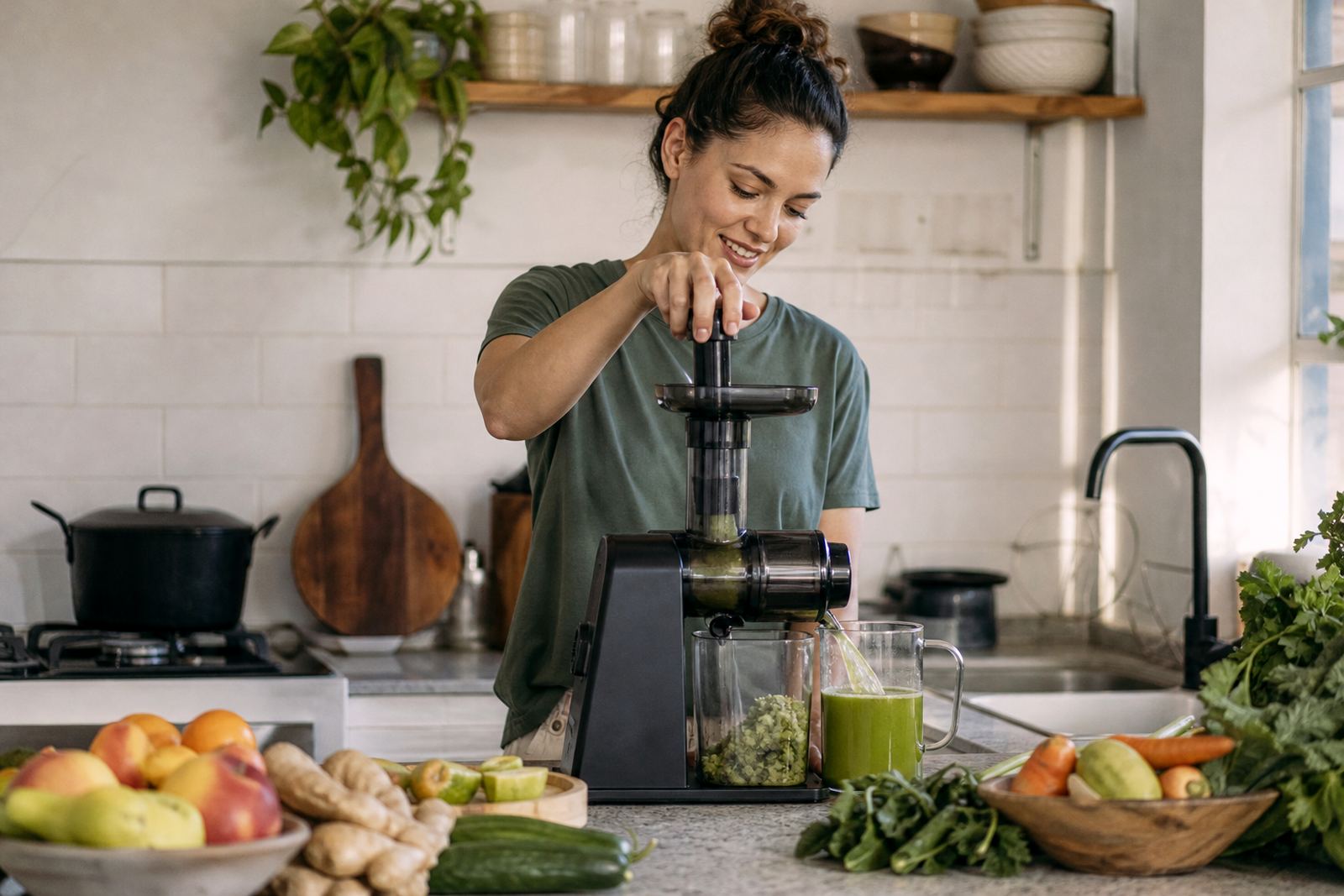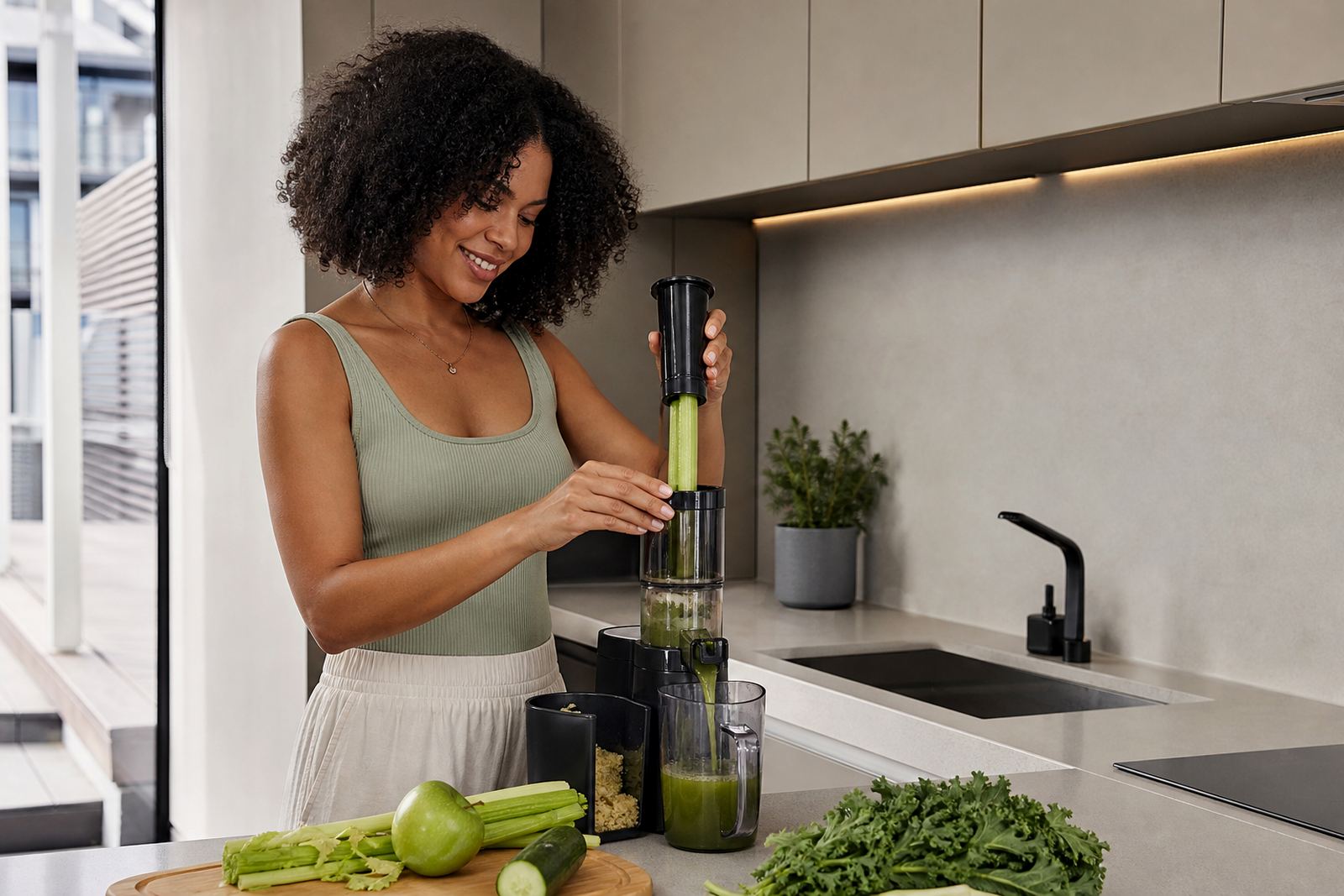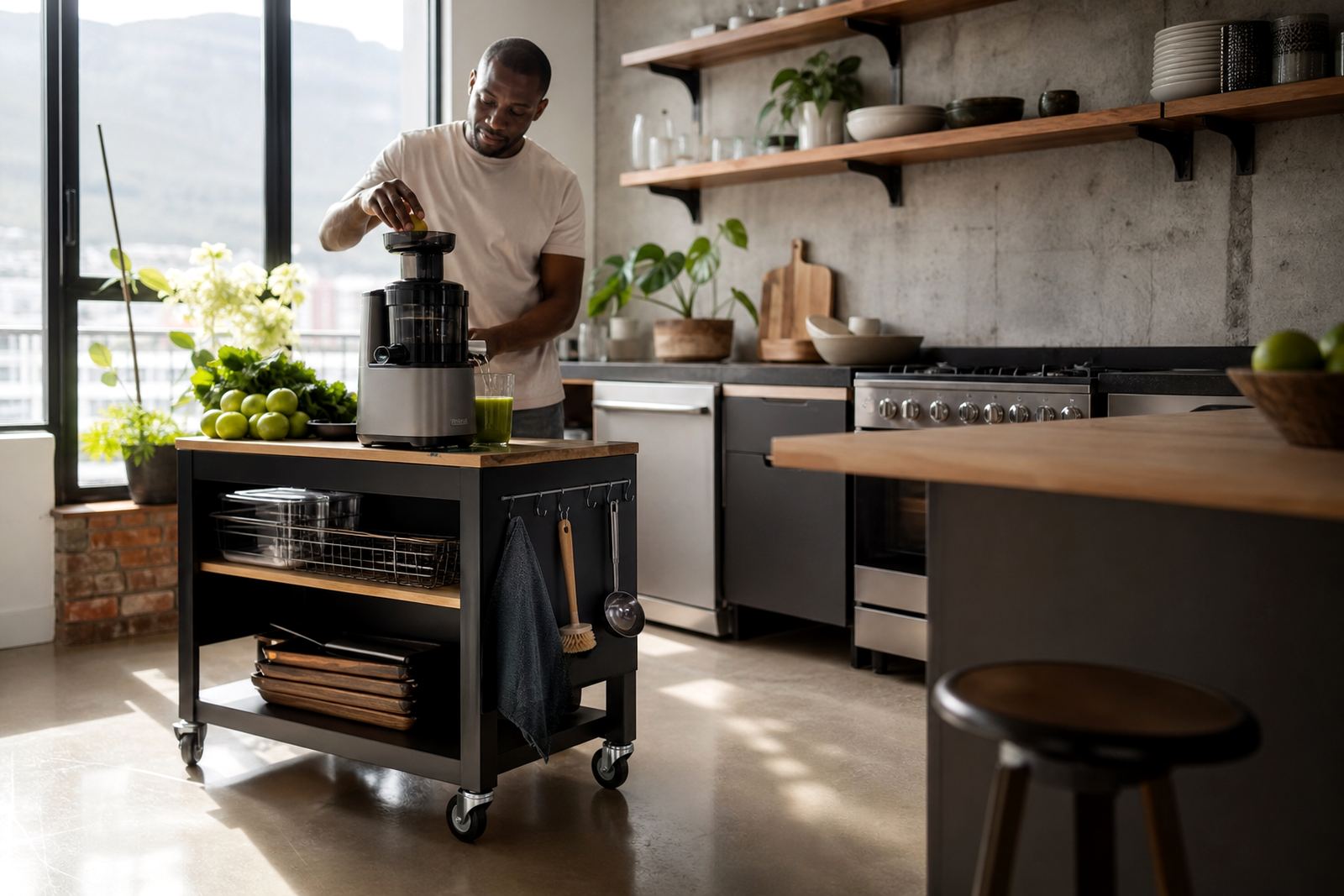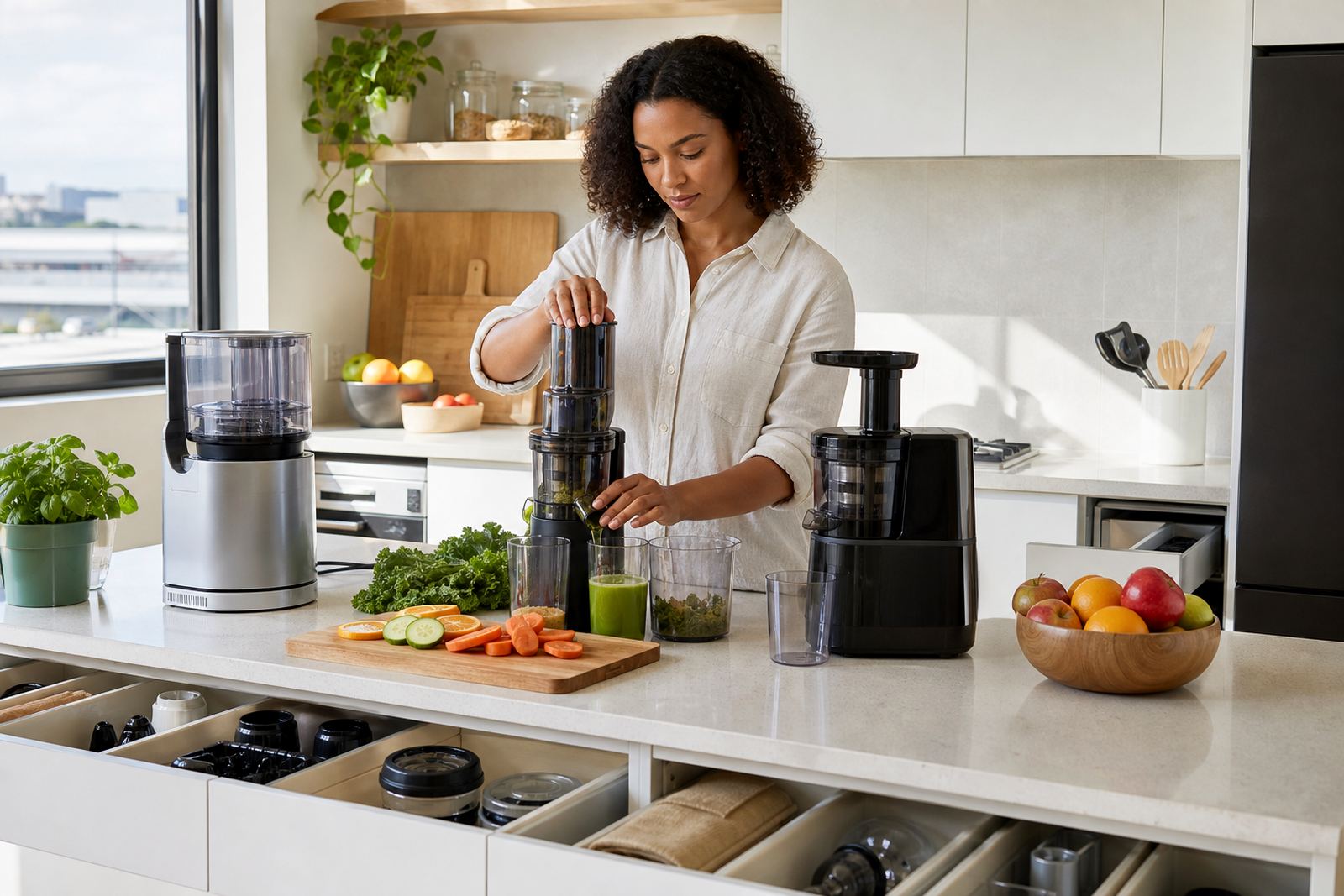
A tight kitchen, one clear place for every part
The studio was in Green Point, Cape Town, in a small apartment where bench space was already spoken for by a kettle, toaster and prep boards. The client needed a home juicing setup that would not sit out all day, because the kitchen also had to stay clear for cooking and washing up. We planned the layout around one base unit, one main work surface, and one dedicated drawer for each accessory, so baskets, strainers, brushes and seals were not left loose in cupboards.
The brief was practical rather than decorative. The client wanted a slow masticating juicer for leafy produce and softer fruit, plus a centrifugal juicer for quicker daily use when speed mattered more than yield. A compact cold press was also included for batches where lower heat and quieter operation were preferred. The key was to keep the footprint small enough for a studio while still giving each machine its own place and safe cable storage.
What made the site tricky
Green Point apartments often come with narrow walkways, limited plug points and shared surfaces that are already doing too much. In this case the kitchen had one main socket near the counter edge, a short run to the sink, and not much room for leaving wet parts to dry.
There were also food safety basics to keep in mind. Juicing equipment needs parts that can be rinsed quickly, dried properly, and stored without trapping moisture. Seals, screens and feed chutes must be easy to inspect, because residue can build up if parts are packed away while still damp. In a small flat, that matters even more because there is less space for air drying and less room to hide a mess.
- One drawer for each accessory, labelled by use
- Short cable runs to reduce clutter at the plug point
- Drying space planned beside the sink, not on the counter
- Storage set up so heavy parts stay low and secure
Machines chosen for different kinds of use
We supplied and set up a slow masticating juicer, a centrifugal juicer and a compact cold press arrangement. The slow masticating unit was selected for its screw-style extraction, which works at a lower speed and handles leafy greens, herbs and firmer fruit with less foaming. The centrifugal model was kept for quicker juicing, using a fast spinning screen and chute for larger batches when speed mattered. The cold press option was specified for the quietest operation and a more measured press, which suited early mornings in a block of flats where noise carries.
The client wanted clear separation between each machine and its accessories. We supplied storage boxes, spare seals, cleaning brushes, a small bottle brush for narrow channels, and a set of tools for routine care. We also checked that the plug points used were safe, that the cables were not stretched across the walkway, and that the equipment could be lifted out without knocking other items over.
- Slow masticating juicer for lower-speed extraction
- Centrifugal juicer for quicker daily use
- Cold press for quieter operation and compact batch work
- Spare seals, brushes and screening care items
Setup, clean-down and safety points
We handled first time setup in the studio and walked the client through assembly, stripping and reassembly. That included how to align the feed chute, seat the screen correctly, check the locking points and make sure seals sat flat before use. We also showed how to listen for unusual vibration, which can point to an unbalanced fit, a loose part or a screen that needs cleaning. Small issues are easier to catch early than after the machine has been used a few times with sticky residue inside.
Cleaning guidance was kept simple but exact. Parts that touch food must be washed soon after use, not left overnight. Juice residue can dry hard in the screen and around the seals, and that makes the next clean much harder. We explained where warm water was enough, where a brush was safer than a cloth, and which parts should be fully dry before storage. The client also received leak troubleshooting help, because even a small drip can leave a studio kitchen messy if it is not checked at the join points.
- First time setup and operating walk-through
- Leak checks at the seal and outlet points
- Noise and vibration checks after assembly
- Cleaning order for screens, chutes and collection parts
A three week handover without wasted motion
Week one covered the site review, measurements and equipment selection. Week two was used for supply, preparation and the setup of the drawer system so the accessories had a fixed place before any juicing started. Week three focused on final checks, clean-down routines, spare parts placement and a short video support call so the client could revisit the steps later if needed. The whole process stayed lean because a studio cannot afford repeated unpacking, especially when there is only one main work zone.
By the end of the handover, the client had a small and orderly juicing point that could be packed away fast after use. The result was better bench control, less clutter in the cupboards and fewer loose items left on the counter. The drawer arrangement also made it easier to keep track of screens, seals and brushes, so routine care was more likely to happen on time rather than when something had already started leaking or rattling.
Why this layout works for small city kitchens
This Green Point project showed that a small kitchen can still hold a proper juicing setup if the storage is planned properly and the equipment matches the way the household actually works. We would use the same approach again for any compact flat in Cape Town or another busy city area: pick the machines by use, keep the accessories separate, and make cleaning part of the layout rather than an afterthought. The one-drawer-per-accessory method sounds plain, but it saves time and stops small parts from disappearing into crowded cupboards.
For a studio, that kind of order matters as much as the machine choice itself. It keeps the counter clear, makes food safety easier to manage and helps the owner use the equipment without turning the kitchen upside down each time.
Key facts
| Project location | Green Point, Cape Town |
|---|---|
| Client type | Private studio apartment owner |
| Equipment supplied | Slow masticating juicer, centrifugal juicer, compact cold press |
| Storage plan | One dedicated drawer per accessory |
| Timeline | 3 weeks from review to handover |
| Support included | First time setup, cleaning guidance, leak troubleshooting, noise vibration checks |